Showing posts with label events. Show all posts
Showing posts with label events. Show all posts
Saturday, January 7, 2012


Saturday, December 17, 2011
2012 Informing Science + IT Education Conference. Jun 22 - 27, 2012
Montreal, Canada. In collaboration with the John Molson School of Business,
Concordia University, Montreal, Canada
Montreal, Canada. In collaboration with the John Molson School of Business,
Concordia University, Montreal, Canada
Sunday, August 7, 2011
Monday, May 30, 2011
Closing Plenary by Noam Chomski at ICA Virtual Conference


The title of the closing plenary was "Democracy, the Media, and the Responsibility of Scholars." The Chair of the conference was Larry Gross, U of Southern California, USA
Rationality/Science, by Noam Chomsky. Z Papers Special Issue, 1995
Noam Chomski (wikipedia)
On Language and Culture. Noam Chomsky interviewed by Wiktor Osiatynski
In Wiktor Osiatynski (ed.), Contrasts: Soviet and American Thinkers Discuss the Future (MacMillan, 1984), pp. 95-101
Interview to Professor Chomski(made via Skype by Laureano Ralon and Alex Eljatib on December 17th, 2010)
Sunday, May 29, 2011
The International Communication Association's Virtual Conference (Session III)


Virtual Conference Session III
Sunday 15:00-16:15 Harbor Ballroom I
Chair: Larry Gross, U of Southern California, USA
Great virtual Conference experience where, appart from having the opportunity of listening to the presenters, an interesting dialogue brilliantly conducted by Larry Gross was held, and we shared about different issues such as the uses of mobiles for taking pictures (which then are published online)and their possibles consequences, or about how the politicians image are built.
This Virtual Conference uses a device of Adobe which allows to see and to listen on live to the speakers, apart from asking them by chat. In this regard, the role of the moderator is very important. He communicated the questions and comments of the virtual participants to the presenters, facilitating the interaction and making possible that virtual participants felt as if we were present at the event.
Friday, May 27, 2011
Actors and Links in the Media System: Applying a Network Perspective to the Study of Media Production, Content and Audience, by Katherine Ognyanova
Astract:
"This work looks into the network mechanisms which underlie the three major parts of the media system: the industry, the content and the audience. It identifies key theoretical frameworks that can be used to explain the formation and dissolution of ties in each of those three areas. The paper outlines a relational interpretation of classic media studies theories and advocates for the use of a network approach to their application in research.
The first three sections of the paper discuss the network structures behind media production, content and consumption. Section one looks into interorganizational ties (industry level), section two deals with semantic relations (content level), while the third section surveys social bonds (audience level). The last part of this study lists five framework packages (or combined approaches) which allow for a comprehensive relational analysis at all three levels of the media system"
Presentation recorded
After reading this work,I find five framework packages really interesting but I do not understand well why the object of study is appproached as a system neither why people are approached as audience.
"This work looks into the network mechanisms which underlie the three major parts of the media system: the industry, the content and the audience. It identifies key theoretical frameworks that can be used to explain the formation and dissolution of ties in each of those three areas. The paper outlines a relational interpretation of classic media studies theories and advocates for the use of a network approach to their application in research.
The first three sections of the paper discuss the network structures behind media production, content and consumption. Section one looks into interorganizational ties (industry level), section two deals with semantic relations (content level), while the third section surveys social bonds (audience level). The last part of this study lists five framework packages (or combined approaches) which allow for a comprehensive relational analysis at all three levels of the media system"
Presentation recorded
After reading this work,I find five framework packages really interesting but I do not understand well why the object of study is appproached as a system neither why people are approached as audience.
Internet Experience and Time Displacement of Traditional News Media Use: An Application of the Theory of the Niche, by Louisa Ha & Ling Fang
Interesting text that, in a way, forecast the future of television (understood as the machine which is just for seeing the contents which are streammed by channels on it) and printed newspapers.
After reading the full text, one question comes to my mind. Is just that the users tend to remplace televison with Internet or is also that the concept of “information” is changing? and, therefore is now understood more as an adjective, instead of as a noum.
After reading the full text, one question comes to my mind. Is just that the users tend to remplace televison with Internet or is also that the concept of “information” is changing? and, therefore is now understood more as an adjective, instead of as a noum.
Niche paper ica.2011
View more presentations from louisaha
The Online Author’s Survival Guide
The Online Author’s Survival Guide, by Kivmars Bowling
Senior Managing Editor, Compass Journals, Wiley-Blackwell.
Very clear and useful text. I like very much with the proposal about sharing the links to the text published by using environments as Second Life. This procedure seems specially adequate when the topics covered by our texts are related to virtual environments.I did not know that Wiley-Blackwell has a place at this Virtual World.This allows you to be teleported to there.
Senior Managing Editor, Compass Journals, Wiley-Blackwell.
Very clear and useful text. I like very much with the proposal about sharing the links to the text published by using environments as Second Life. This procedure seems specially adequate when the topics covered by our texts are related to virtual environments.I did not know that Wiley-Blackwell has a place at this Virtual World.This allows you to be teleported to there.
Thursday, April 28, 2011
Metaversos 2011. III Congres (photos of the workshop performed by Draceina Pinion and gloriagdiagoGalicia)


More and better photos of the Workshop performed by Draceina Pinion and gloriagdiagoGalicia in Second Life, at the simulation of the Palace of Congres which is in Ibiza (Spain)
Congreso Metaversos 2011 in Second Life (album) by James OReilly
Wednesday, April 27, 2011
Metaversos 2011. III Congres (2011, April 28, 29)
Metaversos 2011, will be held at physical world, in Ibiza (Spain) but will be also streamed on live on Second Life,Ibiza The Island, where users could attend all the presentations by being into their avatars.
Presentations are articulated on the below panels:
Art, Technology and Ecology
Art, Geolocation and Society
Education and Virtual Environments
New Perspectives of advertising
Technology and Applications
The April 28, Akemi Mochizuki (Draceina Pinion avatar) and me will perform a workshop in Second Life titled:
The Importance of Designing and Using Devices for indetifying and achieving specific objetives in Virtual Worlds: Word Puzzle Balls, Dracy Words Game, Dracy Board and Brainflowing and which is intended on showing devices which can be used in the Virtual Environment for achieving different purposes and therefore, we aim to point out the importance of using Virtual Worlds not just a tool but as contexts where many tools can be used for achieving a betterment of the diverse activities we accomplish at these environments.
By accesing to this link (Event Time Announcer) you could see the time of the workshop, depending on your living place and it is also included a teleport to the Second Life place where will be done.
Presentations are articulated on the below panels:
Art, Technology and Ecology
Art, Geolocation and Society
Education and Virtual Environments
New Perspectives of advertising
Technology and Applications
The April 28, Akemi Mochizuki (Draceina Pinion avatar) and me will perform a workshop in Second Life titled:
The Importance of Designing and Using Devices for indetifying and achieving specific objetives in Virtual Worlds: Word Puzzle Balls, Dracy Words Game, Dracy Board and Brainflowing and which is intended on showing devices which can be used in the Virtual Environment for achieving different purposes and therefore, we aim to point out the importance of using Virtual Worlds not just a tool but as contexts where many tools can be used for achieving a betterment of the diverse activities we accomplish at these environments.
By accesing to this link (Event Time Announcer) you could see the time of the workshop, depending on your living place and it is also included a teleport to the Second Life place where will be done.
Friday, November 19, 2010
SL ACTIONS 2010
The importance of using devices designed for achieving specific objectives in Second Life. Exemplification by introducing tools which can be applied for improving three issues involved in the Learning Process of a language, by Gloria Gómez-Diago (gloriagdiago Galicia avatar) and Akemy Mochizuki (Draceina Pinion Avatar)
November, 19, 2010.


November, 19, 2010.


Tuesday, November 9, 2010

Friday, November 5, 2010
Friday, October 29, 2010
Friday, October 15, 2010
Improving three elements involved in the learning process of a language by using tools designed for Second Life (SL Languages 2010)
From today SL Languages 2010 begins at Second Life. We encourage you to take a look into the schedule SL Languages Schedule.
Saturday 16 October 2010. 7am PDT (SL Time)/2pm GMT / 10pm CST (China Standard Time)
(See in this link (The Fixed Time World Clock) what is the time of the presentation, depending on where you are.)
In the parallel session 5.1. Parallel session 5.1 Akemi Mochizuki (Draceina Pinion avatar)and me will present:
"Improving three elements involved in the learning process of a language by using tools designed for Second Life. Grammar, Vocabulary and Use in context: Word Puzzle Ball, Dracy Crossword (type 5 and Making Panel) and Brainflowing"
Abatract
Second Life is an adequate environment for learning languages not just because allows to join individuals from several places, facilitating the exchange of ideas between them but also because of the immersive character of this virtual environment, which permits people to share a common space where they can interact with ease and where they feel comfortable. Even without the need of using tools, Second Life, understood as an space is a very adequate place for practicing languages but it is mainstream taking advantage of the easiness that we experiment in this Virtual World for designing and creating intelligent tools oriented to achieve specific objectives involved in the process of learning a language. Therefore, in this demonstration, we will introduce tools focused on practicing three main issues that take part in the learning process of a language:
Word Puzzle Balls and Dracy Crossword (type 5 and Making Panel) are created by Draceina Pinion and aim to help people to improve grammar and vocabulary in many languages. Thus, Word Puzzle Balls can be used for learning and teaching the grammar of all the languages which can be used in Second Life and Dracy Crossword can be applied for learning and teaching vocabulary of English, German, Spanish, French, Italian and Hirigana, the first of all the writing systems taught to Japanese children. Brainflowing, created by gloriagdiagoGalicia and Draceina Pinion is a tool intended on facilitating the brainstorming activity in Second Life. It permits to brainstorm, by using several languages, being very adequate for practicing a language in context. Furthermore, because permits people to brainstorm by anonymity, the learners, will be not afraid of committing mistakes when writing and the teacher could correct them without referring to the persons who have done.
This session lasts for 120 minutes and takes place in AVALON Learning Sandbox
VENUE: AVALON Learning Sandbox
http://maps.secondlife.com/secondlife/AVALON%20Learning/101/65/36
Note: all the tools are available in Dracy´s virtual shop, at Second Life.
http://maps.secondlife.com/secondlife/Zerelia/233/98/74
Saturday 16 October 2010. 7am PDT (SL Time)/2pm GMT / 10pm CST (China Standard Time)
(See in this link (The Fixed Time World Clock) what is the time of the presentation, depending on where you are.)
In the parallel session 5.1. Parallel session 5.1 Akemi Mochizuki (Draceina Pinion avatar)and me will present:
"Improving three elements involved in the learning process of a language by using tools designed for Second Life. Grammar, Vocabulary and Use in context: Word Puzzle Ball, Dracy Crossword (type 5 and Making Panel) and Brainflowing"
Abatract
Second Life is an adequate environment for learning languages not just because allows to join individuals from several places, facilitating the exchange of ideas between them but also because of the immersive character of this virtual environment, which permits people to share a common space where they can interact with ease and where they feel comfortable. Even without the need of using tools, Second Life, understood as an space is a very adequate place for practicing languages but it is mainstream taking advantage of the easiness that we experiment in this Virtual World for designing and creating intelligent tools oriented to achieve specific objectives involved in the process of learning a language. Therefore, in this demonstration, we will introduce tools focused on practicing three main issues that take part in the learning process of a language:
Word Puzzle Balls and Dracy Crossword (type 5 and Making Panel) are created by Draceina Pinion and aim to help people to improve grammar and vocabulary in many languages. Thus, Word Puzzle Balls can be used for learning and teaching the grammar of all the languages which can be used in Second Life and Dracy Crossword can be applied for learning and teaching vocabulary of English, German, Spanish, French, Italian and Hirigana, the first of all the writing systems taught to Japanese children. Brainflowing, created by gloriagdiagoGalicia and Draceina Pinion is a tool intended on facilitating the brainstorming activity in Second Life. It permits to brainstorm, by using several languages, being very adequate for practicing a language in context. Furthermore, because permits people to brainstorm by anonymity, the learners, will be not afraid of committing mistakes when writing and the teacher could correct them without referring to the persons who have done.
This session lasts for 120 minutes and takes place in AVALON Learning Sandbox
VENUE: AVALON Learning Sandbox
http://maps.secondlife.com/secondlife/AVALON%20Learning/101/65/36
Note: all the tools are available in Dracy´s virtual shop, at Second Life.
http://maps.secondlife.com/secondlife/Zerelia/233/98/74
Outcomes obtained after brainstorming at ISTE by using Brainflowing
Note: photos taken by Akemi Mochizuki (Draceina Pinion avatar)


Yesterday, Akemi Mochizuki (Draceina Pinion avatar) and me enjoyed a very nice time presenting and using Brainflowing at ISTE. We thank all of them for their collaboration and engagement and we also thank to Terra Sieberman (Louise Borgnine avatar), who is Membership Development at ISTE (International Society for Technology in Education)
Brainstorming about advantages of Second Life
Participants identified, among others, the following ones:
- global connections,
- collaboration personal
- learning network
- professional opportunities
- meeting people
- Kurka-licious fun
- collaboration
- personal learning network
- professional opportunities
- museums
- art shows
- beauty
- imagination
- creativity
Brainstorming about alternatives to Second Life.
All Participants agree about the bad consequences that the elimantion of spetial prices for educational and non profit places in Second Life not just for these Institutions but also for the users who were atteding the events they organize. We were sharing about the best alternatives to this Virtual World and the following virtual environments were cited:
- Reaction Grid
Based on Unity3D combined with custom software and inworld scripting it is quickly
becoming a hit for high concurrency-easy to login to use cases. System
Architecture PDF. Highlights:Cross Platform Windows & Mac, Browser plugin, Game
Console Ready Iphone/Ipad/Ipod Touch capable, Android Ready, Standard 3D Mesh/CAD
Import, C#/Javascript/Boo Inworld Scripting, Concurrency to 1000+ Per Level, Vivox
Voice
Opensimulator is open source software that is a favorite for educational users on ReactionGrid.
GaiaOnline
World of Warcraft
Blue mars
The Blue Mars Virtual World Platform is made up
of the Blue Mars Client, the Blue Mars Sandbox Editors, BlueMars.com, and the Blue
Mars Servers.
Eve Online
- Wonderland
Open Cobalt Alpha
Open Cobalt Alpha is the first step in a long term
project to make available to all people a free and open source platform for
constructing, accessing, and sharing virtual workspaces for research and
education. This 3D multimedia wiki technology makes it easy to create deeply
collaborative and hyperlinked multi-user virtual workspaces, virtual exhibit
spaces, and game-based learning and training environments that run on all major
software operating systems. By using a peer based messaging protocol to reduce
reliance on server infrastructures for support of basic in world interactions
across many participants, Open Cobalt makes it possible for people hyperlink their
virtual worlds via 3D portals to form a large distributed network of
interconnected collaboration spaces. It also makes it possible for schools and
other organizations to freely set up their own networks of public and private 3D
virtual workspaces that feature integrated web browsing, voice chat, text chat,
and access to remote desktop applications and services.
Croquet
Croquet is a powerful open source software
technology that, in the form of the Croquet Software Developer's Kit (Croquet
SDK), can be used by experienced software developers to create and deploy deeply
collaborative multi-user online virtual world applications on and across multiple
operating systems and devices. Derived from Squeak, the Croquet system features a
peer-based messaging protocol that dramatically reduces the need for server
infrastructures to support virtual world deployment and makes it easy for software
developers to create deeply collaborative applications. Cobalt is a National
Science Foundation-sponsored effort to develop an open source virtual world
browser and authoring toolkit application based on the Croquet technology.
Science Sim
The 3D Internet refers to a currently disparate
but rapidly converging set of 3D technologies used for visualizing 3D information
on the web. This convergence promises to provide a new set of collaborative tools
with application in collaborative visualization, education, training and scientific
discovery. As part of the Supercomputing Conference this year working with
supporters in the community we have made available a virtual world based on the
open source package OpenSim
Jokaydia
The Islands of jokaydia Project is facilitated by
Jo Kay aka jokay Wollongong. It was launched in September 2007 and aims to provide
a space to explore the uses of virtual worlds in education, the arts and social
change. We are a community of practice, and have homes in various virtual worlds
including our very own jokaydiaGRID running on Opensimulator, along with presence
in Second Life, Jibe and Reaction Grid. We are also exploring BlueMars, World of
Warcraft, Aion and a number of other virtual worlds and gaming platforms.
3rd Rock Grid
Within the virtual world you will find houses,
businesses, music clubs, role playing areas, parks, museums, whatever the community
decides to build or develop, either collectively on community property or
individually on your own property. You will also meet and talk to other
individuals, Americans, Canadians, Australians, Europeans, and others from all
corners of the globe.You are represented by a three dimensional “avatar” that you
control , you control the looks, the clothes, and its movement throughout the
virtual world. The possibilities are endless and completely up to you - the
creator! You will find individuals from 18 to 70 and beyond in world, it is not a
predetermined game, with your interaction with the other individuals your world
becomes what you make it.
SpotOn3d
potON3D's ™ 3DWeb Systems empower Internet users to break out of the flat 2D web
page, and GO TO A PLACE on the web – 3DWeb Worlds - where they can experience much
of the same functionality & experience they enjoy in the real world without having
to spend the time or money get to there.
Participants also pointed the fact that there is an HyperGate, teleporter system between worlds which permits to walk to one place to another.Other issue that was pointed out is that OpenSim is much less expensive in comparision with Second Life and in some ways much easier to change.


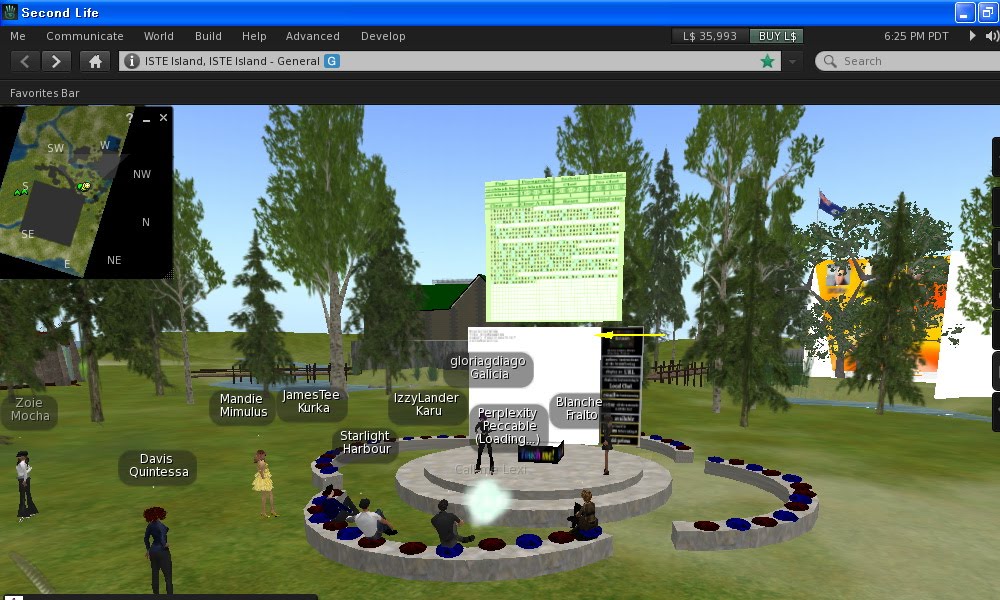
Yesterday, Akemi Mochizuki (Draceina Pinion avatar) and me enjoyed a very nice time presenting and using Brainflowing at ISTE. We thank all of them for their collaboration and engagement and we also thank to Terra Sieberman (Louise Borgnine avatar), who is Membership Development at ISTE (International Society for Technology in Education)
Brainstorming about advantages of Second Life
Participants identified, among others, the following ones:
- global connections,
- collaboration personal
- learning network
- professional opportunities
- meeting people
- Kurka-licious fun
- collaboration
- personal learning network
- professional opportunities
- museums
- art shows
- beauty
- imagination
- creativity
Brainstorming about alternatives to Second Life.
All Participants agree about the bad consequences that the elimantion of spetial prices for educational and non profit places in Second Life not just for these Institutions but also for the users who were atteding the events they organize. We were sharing about the best alternatives to this Virtual World and the following virtual environments were cited:
- Reaction Grid
Based on Unity3D combined with custom software and inworld scripting it is quickly
becoming a hit for high concurrency-easy to login to use cases. System
Architecture PDF. Highlights:Cross Platform Windows & Mac, Browser plugin, Game
Console Ready Iphone/Ipad/Ipod Touch capable, Android Ready, Standard 3D Mesh/CAD
Import, C#/Javascript/Boo Inworld Scripting, Concurrency to 1000+ Per Level, Vivox
Voice
Opensimulator is open source software that is a favorite for educational users on ReactionGrid.
GaiaOnline
World of Warcraft
Blue mars
The Blue Mars Virtual World Platform is made up
of the Blue Mars Client, the Blue Mars Sandbox Editors, BlueMars.com, and the Blue
Mars Servers.
Eve Online
- Wonderland
Open Cobalt Alpha
Open Cobalt Alpha is the first step in a long term
project to make available to all people a free and open source platform for
constructing, accessing, and sharing virtual workspaces for research and
education. This 3D multimedia wiki technology makes it easy to create deeply
collaborative and hyperlinked multi-user virtual workspaces, virtual exhibit
spaces, and game-based learning and training environments that run on all major
software operating systems. By using a peer based messaging protocol to reduce
reliance on server infrastructures for support of basic in world interactions
across many participants, Open Cobalt makes it possible for people hyperlink their
virtual worlds via 3D portals to form a large distributed network of
interconnected collaboration spaces. It also makes it possible for schools and
other organizations to freely set up their own networks of public and private 3D
virtual workspaces that feature integrated web browsing, voice chat, text chat,
and access to remote desktop applications and services.
Croquet
Croquet is a powerful open source software
technology that, in the form of the Croquet Software Developer's Kit (Croquet
SDK), can be used by experienced software developers to create and deploy deeply
collaborative multi-user online virtual world applications on and across multiple
operating systems and devices. Derived from Squeak, the Croquet system features a
peer-based messaging protocol that dramatically reduces the need for server
infrastructures to support virtual world deployment and makes it easy for software
developers to create deeply collaborative applications. Cobalt is a National
Science Foundation-sponsored effort to develop an open source virtual world
browser and authoring toolkit application based on the Croquet technology.
Science Sim
The 3D Internet refers to a currently disparate
but rapidly converging set of 3D technologies used for visualizing 3D information
on the web. This convergence promises to provide a new set of collaborative tools
with application in collaborative visualization, education, training and scientific
discovery. As part of the Supercomputing Conference this year working with
supporters in the community we have made available a virtual world based on the
open source package OpenSim
Jokaydia
The Islands of jokaydia Project is facilitated by
Jo Kay aka jokay Wollongong. It was launched in September 2007 and aims to provide
a space to explore the uses of virtual worlds in education, the arts and social
change. We are a community of practice, and have homes in various virtual worlds
including our very own jokaydiaGRID running on Opensimulator, along with presence
in Second Life, Jibe and Reaction Grid. We are also exploring BlueMars, World of
Warcraft, Aion and a number of other virtual worlds and gaming platforms.
3rd Rock Grid
Within the virtual world you will find houses,
businesses, music clubs, role playing areas, parks, museums, whatever the community
decides to build or develop, either collectively on community property or
individually on your own property. You will also meet and talk to other
individuals, Americans, Canadians, Australians, Europeans, and others from all
corners of the globe.You are represented by a three dimensional “avatar” that you
control , you control the looks, the clothes, and its movement throughout the
virtual world. The possibilities are endless and completely up to you - the
creator! You will find individuals from 18 to 70 and beyond in world, it is not a
predetermined game, with your interaction with the other individuals your world
becomes what you make it.
SpotOn3d
potON3D's ™ 3DWeb Systems empower Internet users to break out of the flat 2D web
page, and GO TO A PLACE on the web – 3DWeb Worlds - where they can experience much
of the same functionality & experience they enjoy in the real world without having
to spend the time or money get to there.
Participants also pointed the fact that there is an HyperGate, teleporter system between worlds which permits to walk to one place to another.Other issue that was pointed out is that OpenSim is much less expensive in comparision with Second Life and in some ways much easier to change.
Thursday, October 14, 2010
Brainstorming with Brainflowing at ISTE (strengths of Second Life and current alternatives to this Virtual Environment)
Thursday, October 14, 2010, 6-7 PM SLT (that's 9PM EST)
ISTE (International Society for Technology in Education) Educators Social Events at Second Life
Facilitator: gloriadiago Galicia & Draceina Pinion
Location: ISTE Island Campfires http://slurl.com/secondlife/ISTE%20Island/182/91/23
Gloria Gómez-Diago (gloriagdiagoGalicia SL) and Akemi Mochizuki (Draceina Pinion SL) will introduce Brainflowing, a device for brainstorming in Second Life, and for transferring the outcomes generated to other contexts. After explaining how the tool works, two brainstorming will be held with all the participants. First we will be focused on identifying tasks which can be undertaken in this Virtual World for achieving objectives involved in a teaching/ learning process. Then, taking in mind the removal of the educational/non-profit discount in Second Life_ issue considered worthy of attention_ we will brainstorm about the current alternatives to this Virtual Environment. Therefore, by sharing experiences about the use of other platforms, we will to seek their salient advantages and failures.
Brainflowing has a symbolic price of 1000 linden Dollars, which are equivalent to $3.64, £2.34 or €2.76, and it is available at Dracy´s Virtual Shop.
http://slurl.com/secondlife/Zerelia/240/105/74
NOTE: Take note of the time of the event depending on your localization by seeing "Worldwide GMT Fixed Time"
ISTE (International Society for Technology in Education) Educators Social Events at Second Life
Facilitator: gloriadiago Galicia & Draceina Pinion
Location: ISTE Island Campfires http://slurl.com/secondlife/ISTE%20Island/182/91/23
Gloria Gómez-Diago (gloriagdiagoGalicia SL) and Akemi Mochizuki (Draceina Pinion SL) will introduce Brainflowing, a device for brainstorming in Second Life, and for transferring the outcomes generated to other contexts. After explaining how the tool works, two brainstorming will be held with all the participants. First we will be focused on identifying tasks which can be undertaken in this Virtual World for achieving objectives involved in a teaching/ learning process. Then, taking in mind the removal of the educational/non-profit discount in Second Life_ issue considered worthy of attention_ we will brainstorm about the current alternatives to this Virtual Environment. Therefore, by sharing experiences about the use of other platforms, we will to seek their salient advantages and failures.
Brainflowing has a symbolic price of 1000 linden Dollars, which are equivalent to $3.64, £2.34 or €2.76, and it is available at Dracy´s Virtual Shop.
http://slurl.com/secondlife/Zerelia/240/105/74
NOTE: Take note of the time of the event depending on your localization by seeing "Worldwide GMT Fixed Time"
Subscribe to:
Posts (Atom)


